Wednesday, May 27, 2009

ALMS On A Budget!

Hey readers,

Well I luckily got the opportunity to attend an ALMS race a few months ago through a friend and I must say it was a fun experience. The downside though was with the economic downturn, the financial strings once holding up teams of the past have now been cut, seeing the disappearance of past '08 teams such as Porsche and Audi, heavy P2 and P1 class competitors, respectively. Acura, however, was still on the playing field in both P1 (the only ones in P1) and P2 classes with amazing cars with hydraulic stabilizers and carbon fiber plate-backed rotors. I must admit the cars were extremely badass, but with all the media coverage and the huge Honda backed budget that the Acura cars got, I turned my attention to another P2 competitor and the underdog, Mazda. Now I'm not one to shoot down technology, but it's nice to see a car on a slightly tighter budget, a more grass roots approach to racing.


The thing I first noticed about the Mazdas were their extremely different exhaust note. The Ferrari GT2 F430 and the high reving, big bore, short stroke Acuras had extremely high pitched exhaust notes, more similar to a shreaking five year old at a Toys R Us. The Mazdas however, had a low howl, and then a loud, low tone hiss once they passed and clipped the candy-cane colored apexes. The reason: a turbo. Rather than sticking to a small displacement, rev happy V-8 like most over P2 cars, Mazda dipped their hands into the water of forced induction. Using a motor which was around the lines of 2.0 litres, Mazda maximized the performance of their small inline four with a fairly large turbo. The ALMS rules obviously allow for this, but rules for turbo'd vehicles are applied to cap the performance and to somewhat keep these cars at par with their competitors. For one, boost is only limited to 1.5 atomospheres (~23 psi) and a restrictor must be used which is situated in front of the compressor inlet. You must be thinking wait, what about turbo lag? Anti-lag is permitted and used by the Mazda team to rocket these things off the line and provide torque at almost all areas of the rev band. A wastegate with a large diaphram must be used to correctly control boost at all times and can be seen in the picture above (black coffee mug looking thing right above the carbon fiber piece next to tire on the bottom of the photograph). And the anti-lag woos the spectators with off-throttle flames and "pops" which echoed off the concrete walls and high rise buildings of Long Beach.

Another thing I really appreciated on the Mazda cars were their simplistic use of materials and design. As can be seen above, carbon fiber was only used for body panels in the rear and small diameter steel tubing prevailed as king on numerous suspension components. Rather than a high tech stabilizer system as was seen on the Acura car which looked like a damper, the Mazdas used steel tube and rod ends which attached to a pair of aluminum "rockers" and a bracket which connected the two sides of the stabilizer system together. You may be asking yourself, then why is there only one bar connected to the rear bracket (JDLAB pun)? The streets of Long Beach isn't your typical track with smooth surfaces and banked turns, and Mazda needed to maximized traction by running a softer set-up. By disconnecting one side of the stabilizer bar system, there essentially is no stabilizer on the car, which allows for maximum droop travel and increased tire grip over bumpy surfaces. Steel tube A-arms were also used and aluminum shims were added to suspension pick-up points to adjust camber and caster. So SIMPO!!!

Alright, so I kinda lied, the car did have a carbon fiber intake manifold, but still it's nothing dramatic like a huge dry carbon intake box with 8 individual throttle bodies and gold foil to dissipate heat. Another cool part was the use of 8 injectors. I know I told you it's a four cylinder, but there is a reason for the method to this madness. Four injectors are situated below the four throttle bodies but above the cylinder head while the other four sit above above the throttle bodies on the intake runners right off the intake manifold. The four closer the intake manifold allow for increased fuel atomization at higher RPM speeds which increases torque and throttle response. I'm sure there is also a special firing technique for anti-lag with these eight injectors but I'm sure the healthy sized guy in the picture wouldn't tell me anymore (after he spilled the beans about the motor displacement, boost pressure, restrictor size and so on).

In the end, the two Mazda LMP2 cars couldn't hold their own against the Acura, but I was informed by an Acura engineer that they were ~6 to 7mph faster down the straights at Long Beach. Why did Mazda run the inline four-turbo instead of the coveted rotary? Reliability? Power? It was probably more along the lines that the Mazdaspeed division who built these engines have become pretty well acquainted and experienced with turbo'd inline fours with their Mazdaspeed 3 and 6. Marketing wise, it does make more sense since their fastest car runs this similar platform and as we all know the RX-8 needs a little more gut before it can be labeled as Mazda's jugernaut.

Well, again thanks for reading and like all of you, I hope the economy resolves itself soon so we can see more competitors out there on the track.

-Josh

Tuesday, May 19, 2009

My take on the "Truth in 24"

Hey all,

I know it's been disappointing the rate at which I'm creating my blogs, but hopefully this will give me enough momentum to keep things going. Recently, my brother told me to download "Truth in 24" for free on Itunes. Now the shitty part is YOU HAVE TO ENTER IN A VALID credit card number to create a shopping account on Itunes. I mean you're essentially buying a free movie, so you gotta do the whole "add in shopping cart" deal. But rather than be a baby about my credit info, I decided to give in seeing that this one particular costumer at work has harrassed everyone about whether or not they've seen this movie. So I clicked the download button and 1.15 gigs later the movie was happily situated in my Itunes.

The story is based upon Audi's 2008 endeavors in the 24 hours of Le mans but revolves around the two diesel power players in the P1 category, Peugeot and them. The car: Audi R10. Seasons this chassis has run: 3. So from the get-go, Peugeot has the lead with a win in a previous 12 hour race at Sebring and of course, they've had more time to develop a P1 chassis using a turbo diesel motor, something still relatively new in the P1 class.

The course: Spa Francorchamps. An over 8 mile long track using public roads full of chicanes, tight and large radius turns, and of course, high speed straights. But with Peugeot's quicker chassis pulling in a 3 sec advantage over Audi per lap, things seem inevitable for Audi to only view the top spot on the podium.

This is where Howden Haynes comes in. Lead engineer for the Allan McNish, Dindo Capello, Tim Kristenson (I know I spelled those wrong for sure) team, he is the voice in the back of their heads guiding them with his computer screens full of telemetry, tire temps, weather reports, and time gaps between theirs and other cars. He is the man that chooses tires, when drivers will swap, and how much fuel goes in. He is their God and the drivers are simply Noah and associated family stuck on an ark waiting for a day storm to end in harmony.

The team sets up shop days earlier before the event, even so to the point they are literally the only ones there, besides maybe janitorial service. They practice tire changes, driver swaps, and fuel fills like it's the track and field events at the summer olympics. Things aren't measured by the second, but rather by the tenth of a second. When the pace is off by half a second, Hayes like any good coach demands more from his team through repetitve practice. All major services for catastrophic failures are even excercised like changing suspension components, body panels, and transmissions. Haynes sees pit strategy as the prominent method for combating the Peugeot team. To Haynes, winning isn't an unreachable goal, but a scent on the tip of his nose that Audi seriously needs after Sebring.

I will worn you that I am about the spoil part of the movie for those who have not seen it, but I feel it is needed to depict the level of confidence and direction that Haynes has. In the last few hours of the race, Haynes quickly calls in his team's car demanding that a tire change be propagated. The driver, in disbelief does not see the need. He's on full slicks and the sun is out after a wet night with only a few wet spots on the track. Haynes demands the driver to pull into the pits, because according to his weather satellite a storm is coming, and an oppurtunity to beat Peugeot is at hand. The car comes in and intermediates are mounted and center-locked into place for a driver who is disgruntled. The car is back on the track and Peugeot begins to cover more distance on their full slicks. However, the storm is back and the sun once shining over France is now covered by clouds waterfalling rain which ends up causing a Peugeot car to spin out. The driver is grateful to Haynes because now the setup (according to the driver) is perfect.

In the end, Audi takes podium and drinks their champagne. But Haynes in a mode of tiredness and zero-energy, quietly makes his way over to a used set of tires to have a seat, a cigarette, and a look at his Iphone. Along the way, drivers, pit crew members, and the ever-so important board of trustees thanks him in ways ranging from a family reunion-like hug to worshippers of pharoah. In the end, he extremely pleased and joyous but in a calm manner due to mental and physical exhaustion. He is the suttle hero that the audience in the grand stands or behind tv screens will usually never see or hear about.

The quality and filmatography of the movie are without a doubt amazing and makes you truly feel as though your on pit lane feeling the anguish, stress, and (in the end) joy of the Audi team. Of course, having Chev Chelios (Jason Statham) do the narrating adds a little bit of spice to a film that your mom, sister, and/or girlfriend would commonly find, well rather boring. I would highly recommend seeing this as it doesn't pinch your wallet in the tough times that we live in.

Cheers,

-Josh

Monday, April 13, 2009

Rock Solid ABS

Hey readers and those who are paid monetarily to read this,

My next post all began from an installation error at work. Now don't be quick to judge the mechanics at work because they are truly amazing at what they do; they are the most OCD people I know when it comes to torque specs and alignments, and they were fully unaware of how "redunkulous" Porsche engineers can be. This all started when a regular costumer with a GT3 needed some serious work done. He went off course at a race track and hopped around 90mph in the dirt sideways. If you think the dirt is forgiving due to the lack of lateral grip your entirely wrong because this car got hurt in the same way the last time you went snowboarding and landed your pale ass over a solid patch of ice. The rear wheels bearings felt more like the fan speed dials on the center console of a cheap car, suspension linkages were bent and battered, and one of the wheels was even bent! So after all these things were replaced, repaired, and installed, the car's ABS light came up. This may have been due to the fact that a rat lived inside this $110,000+ car munching away at wires, but was actually due to the wheel bearings.

After a call from a local dealership who inspected the car due to these warning lights, we learned that the wheel bearings have a particular orientation when they get pressed into the uprights. Now, believe me there is barely a way to have known that these bearings needed a certain direction to get pressed in. The inner and outer races were more similar than the Olsen twins. There aren't any visible arrows or imprinted faces of Heidi Klum telling you this side is "IN" and the other side is "AUS." Rather a very, very close look and perhaps a translator would have been helpful. The local dealership even unknowingly installed a couple wheel bearings in the wrong direction until they received confirmation from Porsche that these things are critical in their orientation in the upright.

Now, even though the bearing can be spun counter-clock or clock wise, why should this set off an ABS light? When you examine the GT3's uprights and look on the back of them (the side not exposed to the guy who is going to steal this car), you'll notice that there are no splines or gear profiles. Unlike the GT3, your average car will have a gear/spline profile behind or somewhere on the upright which spins concentrically with the wheel which ensures proper operation of your anti-lock brake system (ABS; look right 'cause that's probably what you have). An inductive sensor picks up these patterned skips of metal and air as your wheels rotate. If your wheel locks up, the sensor will output a non-pulsating signal because its not picking up any wheel rotation. Your car's ABS system will recognize this and reduce the brake pressure to that wheel or the group of wheels that are locked-up. Porsche decided to bust out their .44 magnum and become Clint Eastwood-badass by not using this method for their ABS sensors. Rather their wheels bearings contained an eccentric magnet at one end.

Magnetized wheel bearings? I know it sounds weird, but just give me a minute and it will all make sense. Porsche in trying to maximize performance perhaps by reducing unsprung weight uses a discreet magnetic sensor which does not need to read off a spline/gear profile. By having a magnet on the wheel bearing, the magnetic sensor can pick up the magnetic field of the magnet on the wheel bearing and create a sinusoidal output to the ABS computer. So if a change in magnetism is not registered by the magnetic sensor, guess what, the wheel or wheels are locked up and the ABS system will reduce pressure to the needed calipers. See why it is so critical to have the bearings pressed in the right direction? Press them in backwards and you have a magnetic sensor that doesn't register anything but air as the magnet on the wheel bearing is too far by a mere 50mm to have it's magnetic field get picked up by the sensor. So why don't most car manufacturers use this method? For one, it is more expensive then your typical inductive sensor layout. Two, it's a GT3. Your paying north of $110,000 for one of the best engineered vehicles in the world and believe me it shows in numerous aspects (just refer to the past posts).

A simple and short post I know, but when I found about these magnetized wheel bearings I felt bad for the technicians BUT again (and as always) appreciated the intellectual pragmatism of Porsche. Sad (I know) that I find these small things exciting, but hey if you're reading this, so do you.

-Josh

Thursday, April 2, 2009

Getting A Grip On Things

Hey All,

Something really impressed at work these past few days, and again it has to do with the same GT3 RS that we took a look at in my first post. I talked briefly about how this certain costumer opted for an after market flywheel and a multi-plate clutch on his car. These two words, flywheel and clutch, which are so mundane within the automotive vernacular literally made me change the way I look at race car engineering. Yet, the two things I'm about to discuss are relatively simple in design, however, make huge leaps and bounds to increase the performance of the vehicle. So let's again dive into things.


The flywheel is typically a steel or chromoly disc with a ring of holes at the center which allow it to be bolted to the crankshaft and an outer gear profile that allows the starter to crank the engine over (not always for some race cars). Steel and chromoly are strong materials and are great for chassis, roll cages, anti-swaybars, and wheel hubs but are quite dense. Freeing up weight at the flywheel allows for a more instantaneous throttle response and quicker acceleration as rotating mass is reduced. The guys at AASCO have taken this truth to the extreme by creating an aluminum based flywheel. Now this may sound weird seeing that aluminum is soft and quick to deform under heat, which is what friction creates. The flyweel takes a good amount of bashing, especially from bad drivers, as it comes in direct contact with the friction discs of the clutch. Having a purely aluminum flywheel would be extremely detrimental as it would mostly likely contort, expand, or shear the surface of it. So as seen in the picture above, the center portion of this specific flywheel has a concentric black ring. This ring is not some anodized aluminum piece, but rather a thin chromoly disc which is attached to the aluminum flywheel using flat socket head cap screws. This allows for a widely lighter flywheel yet still allows for normative grip when compared to typical clutch discs and conventional chromoly flywheels. Another cool thing about this specific piece is that if the chromoly wears down, you simply unfasten the flat head screws and install another chromoly ring.


Next is the Tilton multi-place clutch. The theory behind multiplate clutches is the more discs, the more faces of contact which allows for a higher torque capacity before the clutch slips. Traditional clutches rely on the face which comes into contact with the flywheel. That's why most single disc after market clutches which say they have higher torque capacities have a very stiff clutch-pedal feel. They simply increase the torque capacity by using a pressure plate with more static tension which applies more pressure on the disc. Multi-plates don't have to use this stiff pressure plate method to gain higher torque capacity numbers because your using both sides of several friction discs. Just think of it as sliding two sheets of sand paper on each other versus trying to slide stacks of sand paper upon one another. I have a feeling that the stack is going to be harder...


Lastly, probably the coolest thing that caught my eye about the Tilton setup is the use of a hydraulic release bearing. See typically, the clutch master cylinder moves fluid when the driver depresses the clutch pedal. Since, the fluid has nowhere to go but to the slave cylinder (kinda derogatory calling one cylinder the master and the other the slave, IMO), the fluid from the master cylinder extends a rod which protrudes out of the slave cylinder. This rod on the slave cylinder actuates a hinged fork (kinda like a see-saw) which pushes a ball-bearing. The ball-bearing moves with the motion of the slave cylinder rod and is pushed against the pressure plate, engaging or disengaging the clutch. This specific system eliminates the fork and slave cylinder as the clutch pedal pushes the nearly incompressible fluid into a sleeved cylinder. The pressure causes a volume change and so the height of the hydraulic release bearing rises in the same fashion as a brake piston when the you slam on the brakes. This motion is directly applied to the pressure plate which again engages or disengages the clutch. So essentially the hydraulic release bearing is: 1) the slave cylinder, 2) hinged fork, and 3) release bearing all in one which you have to admit is pretty bad ass. As you can see in the picture above, steel braided line is used to transfer clutch fluid into the hydraulic release bearing. The other line is used as a line for bleeding (removing fluid or air pockets in the clutch system). The bleed line is attached to an external bracket on the side of the transmission case. This bleed line is not necessary but prevents "sailor-mouth" syndrome in mechanics who won't have to remove the transmission every time the clutch system has to be bled.


Well I know there has been a decent pause between this post and the one prior, but I'll try to be a bit more consistent. Till I find something else interesting to write about, I'm over and out.

-Josh

Monday, March 30, 2009

Land of the Rising SUN, no SKY…line

I still remember the days when I found out about the Skyline through the original Gran Turismo and liked the fact that it was one of the faster Japanese Class A cars. However times have changed and instead of seeing it only in video games and on the silver screen, the Skyline GT-R has situated itself in the American market for a while now taking accolades from numerous stateside automotive journals. For instance, Motortrend named this nearly 4000 lbs beast it’s car of the year for 2009, which is pretty unusual seeing the past winners were cars like uh, I don’t know, Civics!? So what can we get from this other than the fact that those of us who are underprivileged enough to have not driven this thing is that the hype is real, more real than Obama for that matter (damn $3.55 trillion plan, sorry Democrat friends). Well, anyways, a few months ago at work we had the opportunity to do some minor work on one, so I decided to snag a few pics, make a few observations, and truly see if the engineering can back up the performance we’ve been reading about for the last year. So let’s have a go!

First off, the brakes (since I’m sure my first post is still fresh in your minds). This rotor is the biggest disc I have ever held besides the “il gigantis” at Ameci’s pizza. Well, for a big car, you need big brakes, and a six piston caliper mated to a 15” in diameter, two-piece rotor with an aluminum center is sure to stop this to its claimed 60 to 0mph in 108 feet which is staggering considering how much of a fat-ass this quick sumo wrestler is. The rear gets a little less love with a 4 piston-caliper and a thinner rotor, but it’s still 15” in diameter, because as we all know, size does matter.

What also is interesting is the fact that the caliper is a mono-block piece. What does that mean exactly? Well these brakes were probably initially casted into the general shape that you see above and were milled and drilled for critical dimensions and hole positions. This process retains the caliper’s structural integrity better when compared to a 2-piece cast design, however, more than likely requires more manufacturing time. What’s really unique about these specific calipers are the holes along the edge of each piston. Reason for these? Not sure but I’d assume it displaces heat due to conduction (the actual contact between two things e.g. non-existent conduction between women and myself) between the brake pad and caliper, and this of course will help in lower brake fluid temperatures.

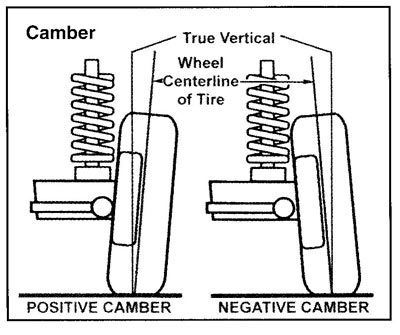
Now if you guys look again towards the first picture (where the right side of the picture is the front of the car), you will notice that the upper suspension arm (A-arm) is angled towards the upper-right. This may seem meaningless to most, but this is Nissan’s engineering proof. With this angle, under suspension compression, the caster angle is going to increase which is great when traveling nearly 200mph and hitting minor bumps. Caster improves the straight-line stability of the car but it also assists in camber. Now the camber angle is on the plane which is perpendicular to the caster angle plane but parallel to the vertical axis (say what?). Just look at the picture below and it should all make sense.

So the more caster angle added, the higher the negative camber angle gain will be when the suspension compresses. This helps this Japanese whale grip ever-so aggressively well even when things seem border line…impossible. As we all know, cars create a roll motion opposite of the direction of the turn. We may try hard to reduce the effects with stiffer springs and better damping, but in end it’s inevitable. In the situation of the GT-R, a little roll is a plus because as the negative camber angle increases, the roll will assist in allowing the contact patch of the tires to be fully employed. What does that mean? It means the car uses more rubber or rather more surface area of the tire which is in one word: good.

Another plus that the GT-R has is its trans-axle transmission. I’m sure you’ve guys heard the term tossed back and forth between magazines, forums, and other blogs but I’ll reduce it down to what I think should be the definition for it: transmission with side-mounted axles. The GT-R is able to retain an almost perfect weight bias by placing the transmission in the back. But wait a minute, isn’t it a 4WD? Yep, it sure is but Nissan drastically changed the drive train layout compared to the R34 to allow this GT-R to hang with the big boys straight off the showroom. See on older GT-Rs, the transmission was essentially similar to a front-engine, rear-wheel drive car like an S2000. You have your longitudinal engine (series of cylinders runs parallel to the side of the car) and right behind it was your transmission and out of the transmission came a driveshaft. The older GT-Rs had a very similar layout, but with a transfer case. What’s critical to note is this transfer case took all the torque traveling parallel with the side of the car and switched it perpendicularly so that the torque would be parallel with the bumpers. Essentially a transfer case “transferred” torque from the driveshaft’s rotations to the front axles. This is problematic. Transfer cases are largely confined because they typically have a lot of things going on next to them: exhaust pipes, the transmission, steering racks, and the driver/passenger’s ass depending on what side of the road you drive on. This of course adds limitations in size which highly affects the strength of the transfer case. Nissan thus saw the several benefits of running a rear mounted transmission because it allows them to create a beefy transfer case in the front of the car. However, this results in two drive shafts: one from the engine to the transmission and another from the transmission to the transfer case. For me, I saw this as a plus, even with the extra driveshaft. With this setup and remembering that all materials have molecular play, the rear tires will have the initial bite when the throttle is applied, allowing for higher torque bias to the rear when disregarding the electronic systems that the car has.

Lastly, I want to discuss the front lower control arm design. Notice the bend that it has for clearance between itself and the tie rod (the steering arm; black rod with the ribbed rubber boot). Most of you may be thinking big deal, the steering rack had to be offset low due to the big V6 motor. To me this is not the case. An issue that several cars and many “tuner” vehicles face is bump-steer. Bump-steer in short is the irregularities of arc movements between suspension arms and the steering arm which causes the wheels to slightly turn when the suspension compresses. Imagine it more like this: bump-steer is like a messed up rainbow where the red arch clearly crosses over all the way into the purple arch and the rainbow is so messed up that it looks like the first picture you drew with a box of crayons. See the colors represent the arc motions of the suspension components. A harmonious and bump-steer-less system needs to be like a rainbow (I know that sounds gay). If the steering arm’s arc of motion were the red arch, it needs to be the bottom arch all the time and in the same way, if the purple arch where the control arm’s arc of motion, it needs to remain as the highest arch. And getting back to the point, Nissan purposely placed that bend in the lower control arm to make sure that the system was bump-steer-less, like a big, gay rainbow.

Well I’m literally out of gas and energy now guys. I’m sorry for the shitty metaphor but that was all I could come up with. Thanks for reading

-Josh

Thursday, March 26, 2009

RADIO TRANSMISSION...actually just transmission

Hey everyone,


Well after yesterday's blog, I decided to dive deeper into the GT3 RS at work. When all the modifications are complete, this thing will be (in all honesty) a track monster. The GT3 is an already capable car at any course and the GT3 RS is even more "balls to the wall." However, this costumer is taking it to the extreme (say it like the bro-punks from "Harold & Kumar") with new coil-overs, a sequential shifter adapter, solid spherical control arm bushings (which replaces shitty factory rubber filled ones), "dry" carbon hood & fenders (the real carbon fiber, not your Import Tuner style fiberglass wet-lay), lexan rear quarter panels and rear windshield, an aluminum flywheel, a multi-plate clutch (which is comparably smaller in diameter than the stock friction plates) and a new final drive. So the owner is pretty much taking a bad ass super car and making it more bad ass by reducing weight and rotational mass while improving the cornering capabilities of the car.


Our main topic today is the transmission. As stated before the final drive was changed for a larger ratio (3.9 to 4.1 I believe) which does reduce the top speed, but in all fairness for quicker acceleration off the line and out of the corner. So lets take a look.


At first glance, anyone can notice the use of fins all along the transmission. They act as gussets reducing the effect of torsional loads (especially from drivers who think they can drive, but in reality, can't) and strengthen up the transmission. This allows for the a smaller amount of aluminum to be use (as in our case, this whole thing is made up of cast-aluminum, but not the gears...dummy). These fins also dissipate heat which allows for a more constant oil viscosity reducing the heat and wear experienced by the gears. To me, this transmission looks beautiful like a piece of art, but unlike the indie art shows I've gone to, this art has a function and purpose.

The major thing that separates this from any other Porsche transmission or 99% of other manual transmissions out there is the built in oil cooler. As you can see in the picture above and in the 2nd picture from the top (where it sits right of the transmission), an aluminum box cools down the gear oil that runs through it. In the transmission sits a small mechanical pump (no electronics here) that runs off another gear and shaft in the transmission. It then runs through this small heat exchanger dissipating heat into the atomosphere. But wait, why are there entries and exits on the aluminum heat exchanger? Porsche, knowing full well that the ambient air will cool down this transmission's temperature (which is in excess of 200 Celsius), knew that coolant would act as a better heat absorper than air. Let's think about this for a second. Your coventional rotating heat lamp will keep your lonely-ass slightly warm in a cold room only when it points at you, however, a hot bath will keep you warm for hours, even when the skin-scathing water is turned off. Water (which is largely what coolant is) absorbs heat well and with a kick-ass cooling system like the one on the GT3 RS with its multiplte radiators and aluminum pipes, dissipates heat extremely well. So these entry ports (right of my hand, covered by a blue towel in the picture above) allows coolant to travel through this aluminum box, cooling down gear oil temps. Genius! What's more to say is that the system is simple, effective, and doesn't rely on the use of electronics (oil temp sensors, electric pumps, etc.) which, come on lets face it, will break sooner than its mechanical counterpart or will become hazardous when the system no longer has power.

Well after getting excited about a transmission out of a nearly $200,000 car with almost $100,000 invested into it, it's time I face reality which has come through a leaky refridgerator and a $375 asking price to fix it.

Cheers,

-Josh


Wednesday, March 25, 2009

Where to begin!

Readers,

First off, I would like to introduce myself. I am a car enthusiast, no wait, an aficionado. I find the engineering, passion (and sometimes, the manufacturing) amazing. Some base their liking of automobiles by the lines and the artistic concepts expressed through vehicles. I on the other try to look deeper, at individual components and the basis for why things are the way they are. However, the true reason for this blog is to keep myself asking why and to assist (well, to try) my mind from becoming a non-progressive, stagnant human organ of post-graduation laziness. I will give my earnest attempt to post 3-4 blogs a week which may be more than I'm asking for. But it really depends on what I see at work, so the more kickass stuff I see, the more I will blog. So, lets dive into things!

My first topic that I would like to discuss are ceramic brakes. Nowadays, ceramic pads and rotors are commonplace with super car manufactures and more recently, with Nissan under the debut of the GT-R Spec-V (which we don't have in the states yet). Ceramics (from what I remember as a student) is the abnormally high concentration of carbon mixed into materials. So how can a commonplace steel rotor be improved by a ceramic rotor. Well for one, lets imagine that a steel rotor is like a sponge cake. Our sponge cake has tons of air pockets most likely full of oxygen and nitrogen (the stuff in the air). Now, instead of a sponge cake lets say our batter of a carbon and steel mixture was used to create a pound cake. The pound cake is packed with less air pockets, however, since our pound cake is a mix of two things, those old air pockets are now full of carbon.

You see, carbon is one of the hardest and smallest particles on the face of the planet. Carbon makes up diamonds, diamonds! There's a reason why "diamonds are forever" and that you can cut or vandilize just about anything with a diamond. But you may be asking, "wait a minute, carbon makes up coal, and coal just falls to pieces when I burn or throw it." But did you know that artificial diamonds can and are made by highly compressing large amounts of coal into small "fake" diamonds? And the mixture of carbon into steel gives us the ceramic rotor.

So, in reference to the cake metaphor, the ceramic rotor is stronger. But what about weight? Due to carbon's strength, less iron can be used to manufacture a rotor and that saves weight. This produces a rotor that is lighter and stronger. And since these air pockets (which are sensitive to heat and cause expansion when pedal pressure is applied) are full of carbon, there is less air and a smaller amount of expansion under hard braking. Last but not least, this reduces rotating mass which aids in later braking and quicker acceleration.

However, due to the reduction of friction (which is common with ceramics as ceramics have even been used over steel in ball bearings), the rotors are pretty shitty in the cold. The pads and rotors thus have to be "warmed-up" before aggressive driving and have a key operating temperature for optimum performance. With the reduction of friction though is the increase in longevity (which is also aided by the added strength) and the technician at work tells me Porsche ceramic rotors will probably last longer than the cars themselves!

But is not worth it in the end? Of course! A rotor that is significantly lighter than its steel counterpart while improving off-the-line and out-of-the-corner performance and improved braking is a wanted must for any enthusiast. However, the price of true ceramic rotors and pads come at a cost. Supposedly, the cost of the ceramic rotors and pads on the GT-R Spec-V are a bit under $50,000 for all four corners, but then again we are talking about a 15 inch rotor. On that expensive note, lets look at some real-life ceramic rotors, the ones below are off a coveted 997 GT3 RS at work.


First thing you should notice is the "two-piece" design. The center on this particular rotor is a cast aluminum piece. The use of aluminum allows for a light-weight rotor and great heat dissipation. However, Porsche engineers have taken it to the next level to make sure that the heat created under braking does not interact with drive-line components (wheel bearings, C.V. joints, etc.).

As you can see, the rotor and the aluminum "hat" (center) do not actually touch. Thus, the only thermal exchange can only occur through the pins (shiny, fat "H" shaped things) that hold the rotor to the hat which again reduces the amount of heat exposed to drive-line components. One of the coolest things about this particular rotor is the female threaded pin. It has a small slit through the center of it, allowing for a slight compression when the bolt that threads to it is properly torqued down. Porsche engineers, in all honesty, never cease to amaze me.

On the back face, Porsche engineers have decided to use a TORX style bolt. The only valid reasons that I can think of for using a TORX style bolt is to reduce over torquing and to avoid clearance issues (and possibly because its a German thing). Another cool thing is if you ever had to change the rotor, you simply unfasten these TORX bolts from the drive pins allowing you to reuse the aluminum hats.


These things compared to the two-piece brake rotors we have at work are WAY lighter. I usually struggle carrying around a 350mm steel rotor with an aluminum hat attached but this piece is at least half the weight of that, and larger in diameter! Well, I've written for over an hour now, so I think its time to take a break. Thanks for reading!

-Josh