
First off, the brakes (since I’m sure my first post is still fresh in your minds). This rotor is the biggest disc I have ever held besides the “il gigantis” at Ameci’s pizza. Well, for a big car, you need big brakes, and a six piston caliper mated to a 15” in diameter, two-piece rotor with an aluminum center is sure to stop this to its claimed 60 to 0mph in 108 feet which is staggering considering how much of a fat-ass this quick sumo wrestler is. The rear gets a little less love with a 4 piston-caliper and a thinner rotor, but it’s still 15” in diameter, because as we all know, size does matter.

What also is interesting is the fact that the caliper is a mono-block piece. What does that mean exactly? Well these brakes were probably initially casted into the general shape that you see above and were milled and drilled for critical dimensions and hole positions. This process retains the caliper’s structural integrity better when compared to a 2-piece cast design, however, more than likely requires more manufacturing time. What’s really unique about these specific calipers are the holes along the edge of each piston. Reason for these? Not sure but I’d assume it displaces heat due to conduction (the actual contact between two things e.g. non-existent conduction between women and myself) between the brake pad and caliper, and this of course will help in lower brake fluid temperatures.
Now if you guys look again towards the first picture (where the right side of the picture is the front of the car), you will notice that the upper suspension arm (A-arm) is angled towards the upper-right. This may seem meaningless to most, but this is Nissan’s engineering proof. With this angle, under suspension compression, the caster angle is going to increase which is great when traveling nearly 200mph and hitting minor bumps. Caster improves the straight-line stability of the car but it also assists in camber. Now the camber angle is on the plane which is perpendicular to the caster angle plane but parallel to the vertical axis (say what?). Just look at the picture below and it should all make sense.

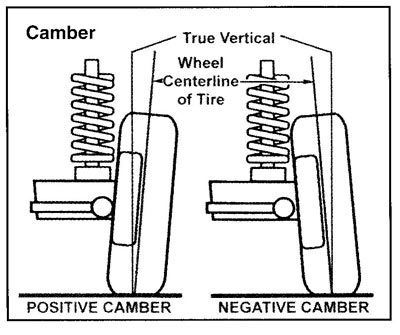
So the more caster angle added, the higher the negative camber angle gain will be when the suspension compresses. This helps this Japanese whale grip ever-so aggressively well even when things seem border line…impossible. As we all know, cars create a roll motion opposite of the direction of the turn. We may try hard to reduce the effects with stiffer springs and better damping, but in end it’s inevitable. In the situation of the GT-R, a little roll is a plus because as the negative camber angle increases, the roll will assist in allowing the contact patch of the tires to be fully employed. What does that mean? It means the car uses more rubber or rather more surface area of the tire which is in one word: good.

Another plus that the GT-R has is its trans-axle transmission. I’m sure you’ve guys heard the term tossed back and forth between magazines, forums, and other blogs but I’ll reduce it down to what I think should be the definition for it: transmission with side-mounted axles. The GT-R is able to retain an almost perfect weight bias by placing the transmission in the back. But wait a minute, isn’t it a 4WD? Yep, it sure is but Nissan drastically changed the drive train layout compared to the R34 to allow this GT-R to hang with the big boys straight off the showroom. See on older GT-Rs, the transmission was essentially similar to a front-engine, rear-wheel drive car like an S2000. You have your longitudinal engine (series of cylinders runs parallel to the side of the car) and right behind it was your transmission and out of the transmission came a driveshaft. The older GT-Rs had a very similar layout, but with a transfer case. What’s critical to note is this transfer case took all the torque traveling parallel with the side of the car and switched it perpendicularly so that the torque would be parallel with the bumpers. Essentially a transfer case “transferred” torque from the driveshaft’s rotations to the front axles. This is problematic. Transfer cases are largely confined because they typically have a lot of things going on next to them: exhaust pipes, the transmission, steering racks, and the driver/passenger’s ass depending on what side of the road you drive on. This of course adds limitations in size which highly affects the strength of the transfer case. Nissan thus saw the several benefits of running a rear mounted transmission because it allows them to create a beefy transfer case in the front of the car. However, this results in two drive shafts: one from the engine to the transmission and another from the transmission to the transfer case. For me, I saw this as a plus, even with the extra driveshaft. With this setup and remembering that all materials have molecular play, the rear tires will have the initial bite when the throttle is applied, allowing for higher torque bias to the rear when disregarding the electronic systems that the car has.

Lastly, I want to discuss the front lower control arm design. Notice the bend that it has for clearance between itself and the tie rod (the steering arm; black rod with the ribbed rubber boot). Most of you may be thinking big deal, the steering rack had to be offset low due to the big V6 motor. To me this is not the case. An issue that several cars and many “tuner” vehicles face is bump-steer. Bump-steer in short is the irregularities of arc movements between suspension arms and the steering arm which causes the wheels to slightly turn when the suspension compresses. Imagine it more like this: bump-steer is like a messed up rainbow where the red arch clearly crosses over all the way into the purple arch and the rainbow is so messed up that it looks like the first picture you drew with a box of crayons. See the colors represent the arc motions of the suspension components. A harmonious and bump-steer-less system needs to be like a rainbow (I know that sounds gay). If the steering arm’s arc of motion were the red arch, it needs to be the bottom arch all the time and in the same way, if the purple arch where the control arm’s arc of motion, it needs to remain as the highest arch. And getting back to the point, Nissan purposely placed that bend in the lower control arm to make sure that the system was bump-steer-less, like a big, gay rainbow.

Well I’m literally out of gas and energy now guys. I’m sorry for the shitty metaphor but that was all I could come up with. Thanks for reading
-Josh


